




The Lord’s Supper, or Holy Communion, is a regular fixture in church life. Familiarity often breeds routine, and over the centuries, this routine has obscured the true power of the meal. Many view it simply as a solemn ritual of remembrance. Others experience deep anxiety, searching for hidden faults before they partake because they worry they are unworthy.
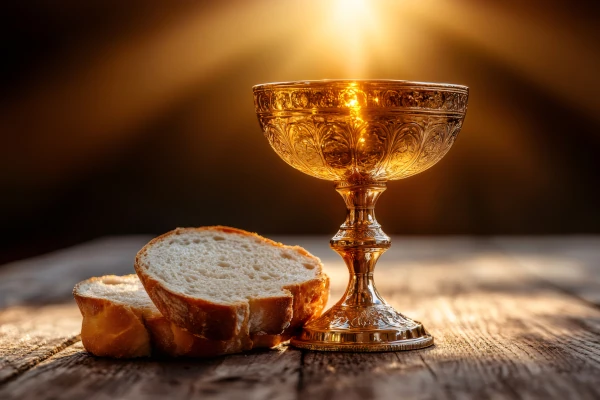 However, the Holy Communion is a tangible gift from God designed to bring life and health. To understand the provision in the bread and the cup, we need to go back to Egypt and examine the first Passover. The Old Testament contains the shadow, and the New Testament reveals the substance.
Exodus 12 sets the scene. The Israelites were slaves in Egypt for four hundred years. They were exhausted from hard labour. On the eve of their deliverance, God instituted the Passover meal.
God told every family to take a lamb without blemish. They killed the lamb and struck its blood on the side posts and upper doorpost of their houses. Then, they roasted the lamb and ate the meat that night.
The blood on the doorposts provided protection. When the angel of death passed through Egypt, it saw the blood and passed over their homes. The blood satisfied the righteous judgement of God.
God also commanded them to eat the roasted meat. The blood provided forgiveness, and the roasted lamb provided physical nourishment. They were about to begin a long journey into the wilderness on foot. They needed strength. The roasting in the fire was a prophetic picture of Jesus Christ. He is the true Lamb of God who bore the fire of God’s judgement for us. Every part of the lamb was consumed, pointing to the complete provision in Christ.
Psalm 105:37 provides a historical account of the next morning:
"He also brought them out with silver and gold, and there was none feeble among His tribes."
Between two and three million Israelites walked out of Egypt. They had spent their lives making bricks and building cities under the whips of taskmasters. Yet, there were no sick people amongst them. No one was frail or unable to walk. No one was feeble.
This was a supernatural manifestation of health. When they ate the roasted lamb, divine life entered their bodies. God healed their physical ailments during that meal.
The Passover lamb in the Old Testament brought healing to millions. The body of our Lord Jesus Christ provides the exact same provision for us today. The Israelites ate a literal lamb. We partake of the bread that represents the true Lamb.
This provision continued past Egypt. As the Israelites journeyed through the wilderness, they had no hospitals or doctors. God provided them with Manna.
Psalm 78 calls Manna the "bread of heaven" and "angels' food". God fed them with bread that sustained their health in a desert for forty years. Centuries later, Jesus declared in John 6, "I am the living bread which came down from heaven. If anyone eats of this bread, he will live forever."
Jesus showed that the Manna and the Passover lamb pointed directly to Him. The Old Testament peace offerings also involved the priests eating the meat of the sacrifice. This was a picture of fellowshipping with God through a meal.
This brings us to the New Testament and the upper room. It was the night before the crucifixion. Jesus celebrated the Passover with His disciples. During this meal, He established the New Covenant Holy Communion.
Matthew 26 records the moment: "And as they were eating, Jesus took bread, blessed and broke it, and gave it to the disciples and said, ‘Take, eat; this is My body.’ Then He took the cup, and gave thanks, and gave it to them, saying, ‘Drink from it, all of you. For this is My blood of the new covenant...’"
Jesus instituted two elements. He provided the bread for His body and the cup for His blood. He separated them deliberately.
The blood is for the remission of our sins. It washes us clean and protects us from judgement, exactly like the blood on the doorposts in Egypt.
When Jesus broke the bread, He prophesied what would happen to His physical body. Isaiah 53 says, "He was wounded for our transgressions... and by His stripes we are healed." The Roman soldiers tied Jesus to a whipping post. They used a scourge to tear His back. His body was broken so that our bodies could be made whole. He bore that physical punishment to purchase our physical healing. Disease and sickness were placed upon Him.
The Apostle Paul taught the early church about forgiveness through the blood and healing through the body. He received his revelation of the Communion directly from the Lord.
In 1 Corinthians 11, Paul provides detailed instruction on the Lord’s Supper. He addresses a specific problem in the Corinthian church.
Paul writes: "For he who eats and drinks in an unworthy manner eats and drinks judgement to himself, not discerning the Lord’s body. For this reason many are weak and sick among you, and many sleep." (1 Corinthians 11:29-30).
The church has often focused on the phrase "in an unworthy manner". People often teach that unconfessed sin makes a person unworthy to partake. Because of this, some believers avoid the Communion table. They fear they will bring punishment upon themselves.
Paul gives a specific reason why people were weak and sick. He states it is due to "not discerning the Lord’s body."
To partake unworthily means a failure to recognise what the body of Jesus was broken for. A person might take the cup and thank God for salvation, while ignoring the bread's purpose for physical healing. The blood and the body have different applications.
When we fail to discern the Lord's body, we miss out on healing. This is the reason Paul stated that many in the church were sick. They did not appropriate the cure because they did not understand it. They treated the bread as common food.
The early church understood this provision. The book of Acts records that the first Christians broke bread from house to house. They partook of the Communion daily. They did not wait for a special Sunday service or an ordained minister to serve them. They understood it was a meal of healing and life.
You can take Communion at home. You can take it with your family. You can use whatever bread and grape juice you have available. The elements themselves have no magic power. The power is in your faith and your discernment of the Lord's body.
The Holy Communion is a divine supply. It is an ordained channel of health and life.
When you next hold the bread, remember the Israelites in Egypt. Remember Jesus on the cross taking sickness and pain into His physical body.
When you eat the bread, say, "Lord Jesus, Your body was broken so that mine can be made whole. I discern Your body, and I receive Your healing today."
When you take the cup, rejoice that your sins are forgiven. You are righteous because of His shed blood.
We can partake of this meal with faith. As we do, it can be said of us, just as it was of the Israelites: there is none feeble amongst us.

